
If you’ve ever run your hand over a stainless steel surface that felt smooth, looked uniformly matte, and showed no fingerprints no matter how much you touched it, there’s a good chance you were looking at a bead blast finish. It’s one of the most popular surface treatments in the stainless steel world, prized for its clean aesthetic and practical performance. Here’s everything you need to know about it.
What Is Bead Blasting?
Bead blasting is a surface finishing process where fine glass beads (or sometimes ceramic or ceramic-glass composite media) are propelled at high velocity against a metal surface using compressed air. Unlike sandblasting, which uses angular abrasive particles that cut and gouge the surface, bead blasting uses spherical media that peen the surface instead — gently deforming it rather than tearing it.
The result is a uniform, satin-like, non-directional matte finish with a soft, slightly frosted appearance. It’s often referred to by finish codes such as No. 8 bead blast or simply BB finish in the metal fabrication industry, though naming conventions vary by manufacturer and region.
How the Process Works
- 1. Surface preparation – The stainless steel part is cleaned to remove oils, dirt, and any existing coatings that could interfere with an even finish.
- 2. Media selection – Glass beads of a specific size (measured in mesh grit) are chosen based on the desired texture. Finer beads produce a smoother, more refined matte look; coarser beads create a rougher, more textured surface.
- 3. Blasting – The beads are blasted onto the surface at controlled pressure and distance, either manually with a blast gun or automatically in a blast cabinet for consistent, repeatable results.
- 4. Passivation (optional but common) – After blasting, many stainless parts undergo a passivation treatment to restore the protective chromium oxide layer that blasting can disturb, ensuring corrosion resistance isn’t compromised.
- 5. Inspection and cleaning – The finished part is cleaned of any residual media and inspected for uniformity.
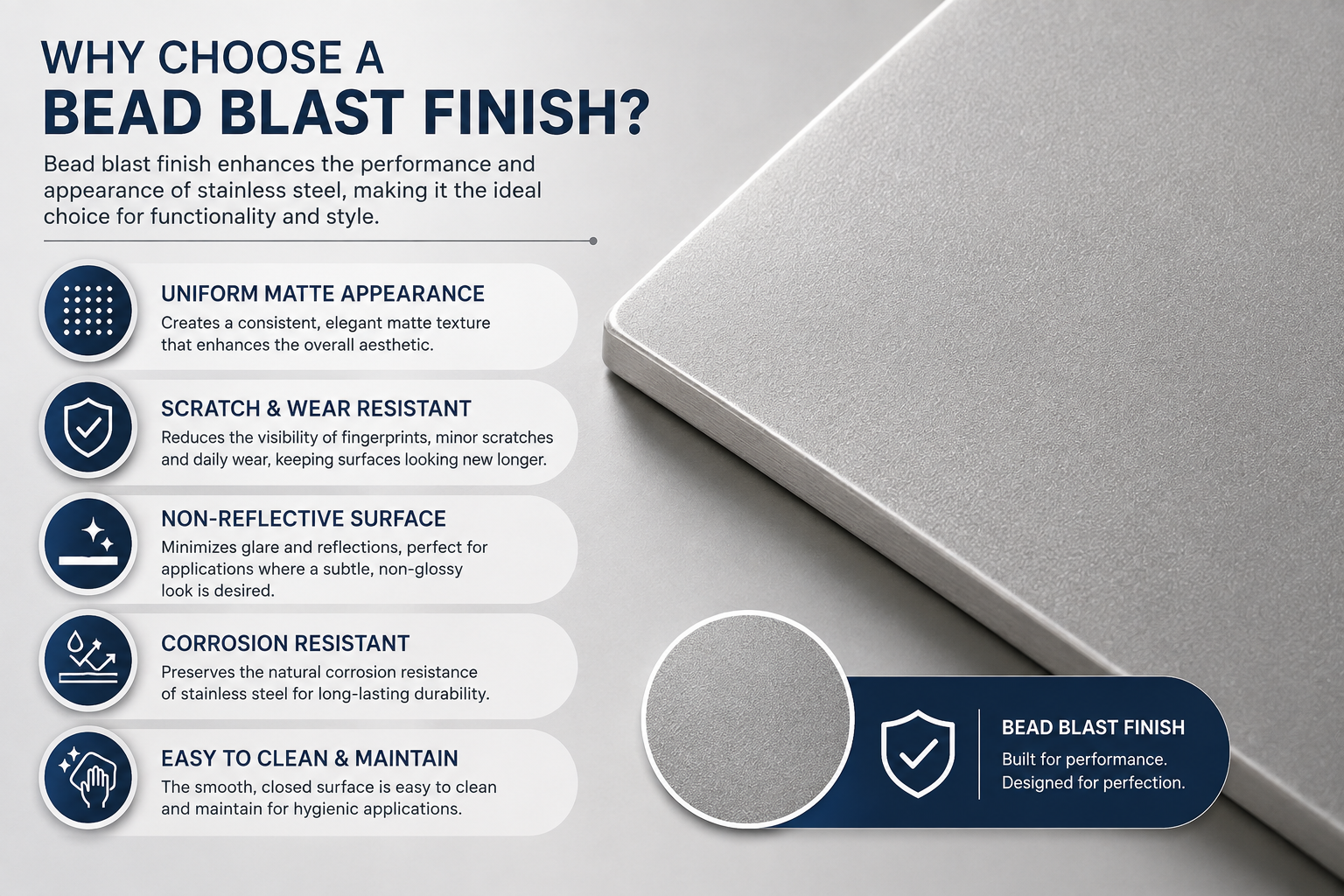
Why Choose a Bead Blast Finish?
Aesthetic appeal Bead blasting gives stainless steel a soft, even, low-sheen appearance that reads as modern and understated. It lacks the mirror reflection of a polished finish but also avoids the directional graininess of a brushed finish, making it a popular choice for architectural and design-forward applications.
Fingerprint and smudge resistance Because the surface texture scatters light rather than reflecting it cleanly, bead-blasted stainless is far less prone to showing fingerprints and smudges compared to polished or mirror finishes. This makes it a favorite for high-touch surfaces like door handles, kitchen appliances, and handrails.
Uniformity without direction Unlike brushed or satin finishes that have a visible grain running in one direction, bead blasting is non-directional. This is especially useful on complex geometries, welds, or curved surfaces where a directional finish would be difficult to apply evenly.
Surface preparation for coatings The slightly roughened, uniform texture created by bead blasting improves the mechanical adhesion of paints, powder coatings, or other surface treatments applied afterward.
Stress relief and improved fatigue resistance Because bead blasting peens the surface rather than cutting it, it can introduce beneficial compressive residual stresses into the metal — similar in principle to shot peening — which can modestly improve fatigue resistance in some applications.
Common Applications
- Architectural hardware – door pulls, handrails, elevator panels, signage
- Kitchen and food service equipment – sinks, countertops, appliance panels
- Medical devices – instrument housings and components where a clean, low-glare, hygienic look is valued
- Firearms and knives – a widely used finish for slides, frames, and blades
- Jewelry and watches – a soft matte texture as a contrast to polished elements
Bead Blast vs. Other Common Finishes
| Finish | Texture | Directionality | Typical Use Case |
|---|---|---|---|
| Bead Blast | Soft, matte, frosted | Non-directional | Hardware, appliances, medical |
| Brushed (Satin) | Fine linear grain | Directional | Appliances, architectural panels |
| Polished (Mirror) | High gloss, reflective | Non-directional | Decorative trim, high-end fixtures |
| Sandblast | Coarser, more aggressive matte | Non-directional | Industrial parts, pre-coating prep |
Maintenance Tips
Bead-blasted stainless steel is relatively low-maintenance, but a few practices help preserve its appearance:
- Clean with a soft cloth and mild soap or a stainless-specific cleaner — avoid abrasive pads that can create shiny scratches on the matte surface.
- Avoid chloride-heavy cleaners (like some bleach-based products), which can compromise the passive oxide layer over time.
- Wipe in the same general motion rather than circular scrubbing to avoid creating uneven sheen spots.
- For outdoor or marine environments, periodic rinsing helps prevent salt or mineral buildup that could lead to surface staining.
A bead blast finish strikes a balance that’s hard to beat: it looks refined without being flashy, resists fingerprints without sacrificing style, and holds up well across a huge range of applications — from a kitchen faucet to a surgical instrument to a knife handle. If you’re choosing a stainless steel finish and want something clean, modern, and forgiving in daily use, bead blasting is well worth considering.